Overview
In high-volume additive manufacturing, success is determined by process stability. A single failed AI print doesn’t just waste material. It consumes machine time, reduces utilization, interrupts automated workflows, and drives up total cost per part.
One of the most common and costly failures in FDM is part detachment from the print bed. When this happens, extrusion continues without a part in place, creating the tangled material often called “spaghetti.” These failures are not always detected by traditional printer telemetry, because temperature, motion, and extrusion data can remain within expected ranges even after the build has already failed.
As organizations move from prototyping to true production, relying on manual checks or basic sensor thresholds becomes a bottleneck. Scalable additive manufacturing requires intelligent, real-time failure detection that can see what the machine cannot measure.
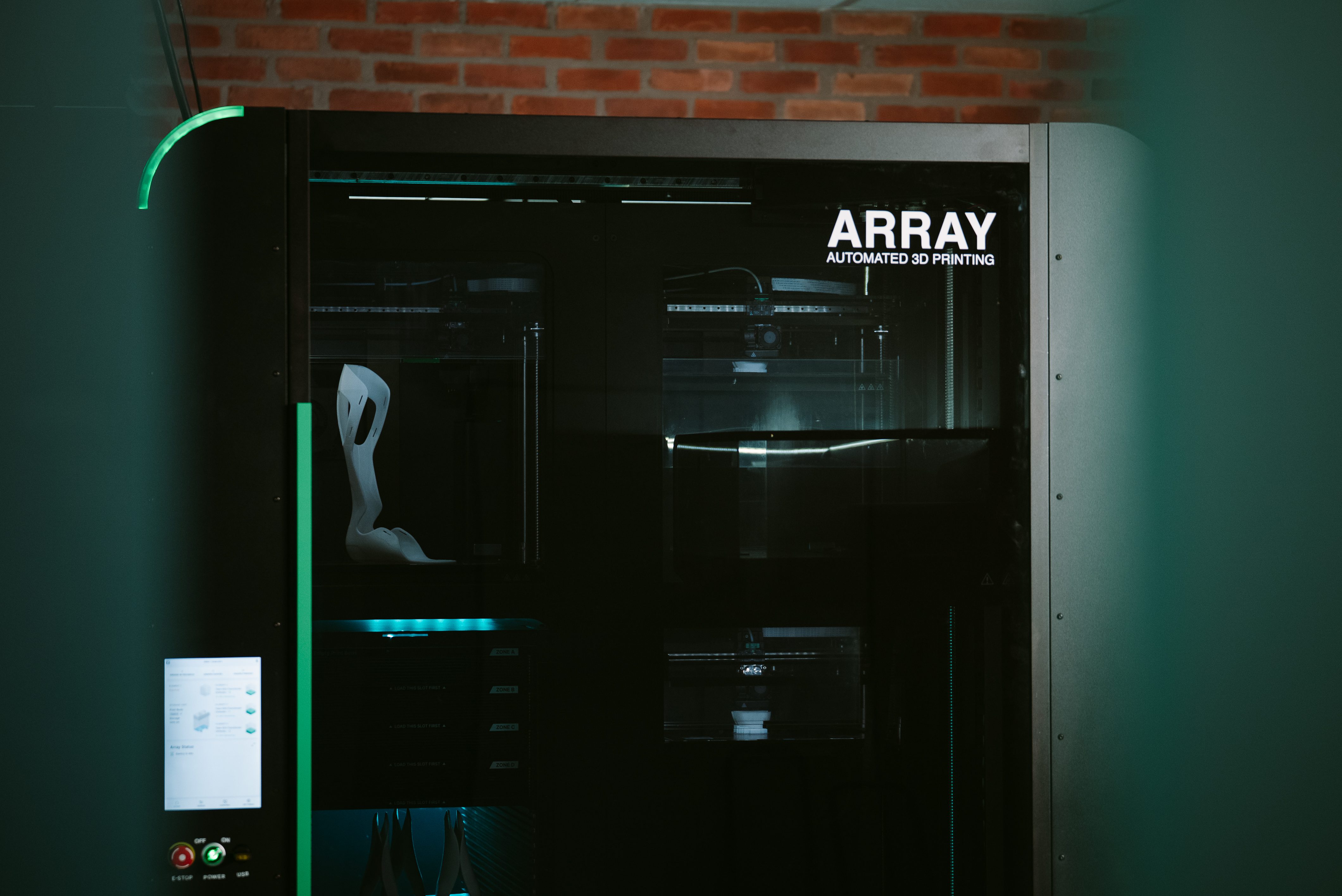
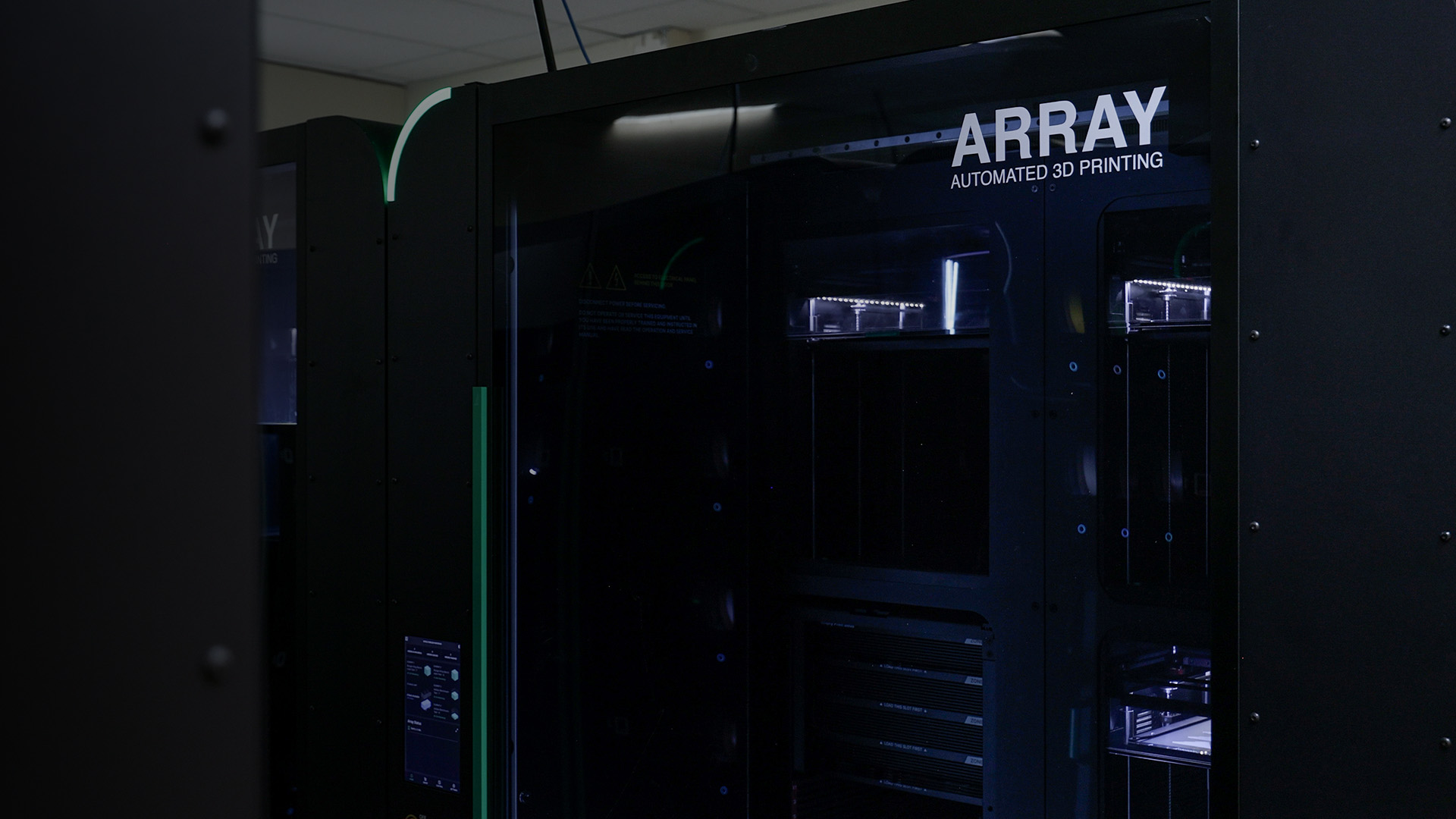
This article explains how Mosaic’s AI Print Failure Detection uses on-device computer vision to identify failures as they happen, how it integrates with Element and Array, and why local AI processing improves throughput, security, and production reliability.
The Problem: Undetected Failures Reduce Throughput
Spaghetti failures occur when a part loses adhesion and the printer continues depositing material without a valid build. Because core telemetry – temperature, motion, and extrusion – can remain within normal ranges, the system has no reliable way to recognize the failure.
The result is not just a scrap part, but lost production time.
In an automated, high-volume environment, every undetected failure reduces utilization, interrupts low-touch operation, and increases total cost per part.
What Real-Time Failure Detection Enables on Array
AI Print Failure Detection applies on-device computer vision to continuously analyze in-process builds and recognize visual failure patterns, including spaghetti formation caused by part detachment. Instead of discovering a failure after the print is complete, the system evaluates image data in real time to determine whether the build’s structure is developing as expected.
AI Print Failure Detection is integrated directly into Mosaic’s automated ecosystem:
- Image Capture During Printing
- Each Element captures an image of the build area once per minute using its onboard webcam
- Local Image Processing
- Images are transmitted to Array, where a trained computer vision model processes them
- Failure Detection
- The AI model evaluates whether spaghetti-like strand formation or abnormal extrusion patterns are present
- Configurable Response
- If an print failure is detected, users can configure the Element to:
- Notify Only
- Notify and automatically pause the print
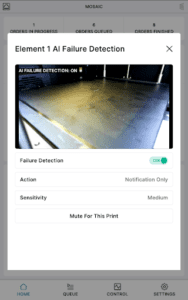
- Users can also adjust detection sensitivity to reduce false positives or false negatives depending on their operational requirements.
- If an print failure is detected, users can configure the Element to:
Production Impact: Turning Detection Into Capacity
AI-driven failure detection improves production performance across the metrics that matter in automated additive manufacturing:
Reduced Material Waste
Spaghetti failures are stopped as they occur, preventing unnecessary filament consumption and preserving available machine time for valid builds.
Lower Risk of Hardware Damage
Halting extrusion before material accumulates around the hot end prevents filament from fully encasing the print head or seeping into the electronics, minimizing cleanup, reducing mechanical strain, and avoiding irreversible damage to the print head that can take the system out of production.
Higher Uptime
Real-time detection shortens the gap between failure and response, allowing Array to return to productive operation faster.
Scalable Fleet Oversight
Operators no longer need to visually supervise every active build. 3D printer fleets can grow without a proportional increase in manual monitoring.
Secure, On-Device Processing
All image analysis runs locally on Array. No build images are transmitted to the cloud, enabling this capability in air-gapped, regulated, and IP-sensitive environments.
For organizations investing in secure, Canadian-engineered manufacturing infrastructure, on-device AI adds another layer of resilience, reinforcing Array as a self-contained, production-ready additive platform.
User Interface Integration
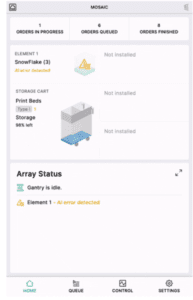
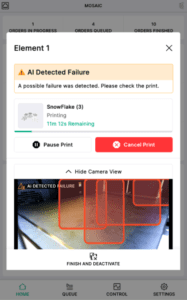
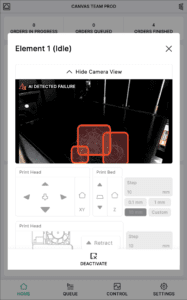
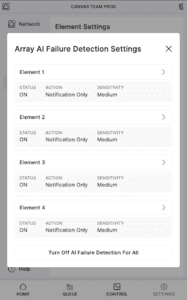
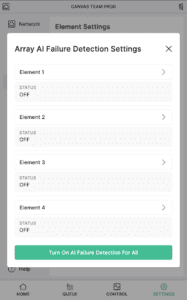
The AI Print Failure Detection system is fully integrated into the Mosaic interface, including:
Array front screen when an error is detected
AI settings menu
Element modal with a failure detected
Picture of Element screen with a real failure
AI settings page for the Array
Ready to Strengthen Your Additive Manufacturing Workflow?
As additive manufacturing scales into true production, real-time failure detection becomes a core requirement for protecting throughput, utilization, and cost per part. With AI Print Failure Detection built into Element and Array, manufacturers can stop spaghetti failures as they occur, safeguard their equipment, and keep automated workflows running without relying on cloud connectivity or additional infrastructure.
Whether you’re expanding a high-volume printer fleet, moving from prototyping to end part production, or deploying additive in a secure, IP-sensitive environment, Mosaic provides a self-contained platform designed for stable, repeatable output at scale.
Contact our team to discuss your production goals:
sales@mosaicmanufacturing.com