Overview & Introduction
Additive manufacturing in aerospace and defence has moved well past the prototyping stage. Across the global defence industrial base, 3D printing for aerospace and military applications is now being evaluated and deployed as a core production capability. It is reshaping supply chains, enabling on-demand production, and giving defence organizations a level of manufacturing agility that traditional methods simply cannot match.
The reason for this shift is structural. Traditional manufacturing was built for stable supply chains, predictable lead times, and long production runs. That world has changed. The COVID-19 pandemic exposed single-source dependencies that no one had planned for. Russia’s invasion of Ukraine accelerated pressure on NATO allies to rebuild domestic production capacity. Geopolitical tension has turned foreign-controlled supply chains from an efficiency concern into a national security liability.
At the same time, defence platforms are getting more complex while remaining in service longer. The combination of obsolete parts, unavailable tooling, and overstretched supply chains has created a manufacturing gap that cannot be closed by ordering faster or stockpiling more inventory.
Additive manufacturing in the aerospace industry addresses this problem directly. It enables:
- On-demand production of critical components without tooling or long lead times
- Lightweight structural designs that improve system performance
- Localized production closer to where parts are actually needed
- Faster design iteration across R&D and procurement cycles
- Sovereign, domestically controlled manufacturing that meets allied-origin procurement requirements
This guide covers how 3D printing in the aerospace and defence market is being adopted across three distinct groups driving this shift: defence primes and tier 1 contractors, drone and UAS manufacturers, and government procurement agencies. For each, the applications, materials, and strategic considerations are different. The underlying imperative is the same: build supply chain resilience, reduce foreign dependency, and scale production on your own terms.
The Supply Chain Problem Driving Additive Manufacturing Adoption
Before examining specific applications, it is worth being direct about why additive manufacturing defence industry adoption is accelerating now.
For defence primes and tier 1 contractors, the core pressure is lead time and legacy parts. Traditional aerospace supply chains often require 18-month lead times for cast or forged components. When a platform has been in service for 30 years and a supplier has discontinued a part, waiting 18 months is not viable.
Additive manufacturing compresses those timelines from months to days. A component that no longer exists in a supply chain can be reverse-engineered, digitized, and printed without standing up an entirely new machining process. This is supply chain innovation in its most practical form.
For drone and UAS manufacturers, the pressure is unit economics and iteration speed. The domestic UAS market is expanding rapidly, but scaling from small prototype runs to volume production requires production systems, qualified suppliers, and consistent output. All of that takes time to develop, even when demand is strong. Additive manufacturing allows manufacturers to scale output without proportional increases in tooling cost or headcount, while maintaining the design flexibility that defence customers increasingly require.

For government procurement agencies, the issue is dependency. The DoD (department of defence) relies on a global network of more than 200,000 suppliers. The GAO has documented foreign dependency risks across eight supply chain priority areas. Canada’s Defence Industrial Strategy has set a target of directing 70% of defence acquisitions to Canadian companies. The U.S. NDAA for FY2026 formally prohibits the DoD from procuring 3D printers made in or digitally connected to China, Russia, Iran, or North Korea. In Europe, the EU’s SAFE regulation and NATO’s Updated Defence Production Action Plan are codifying domestic advanced manufacturing as a strategic requirement.
For procurement agencies, additive manufacturing is not simply a faster way to make parts. It is becoming an instrument of industrial policy and a tool for rebuilding supply chain resilience at a national level.
Core Applications of 3D Printing in Aerospace and Defence
Rapid Prototyping and Defence R&D
Rapid prototyping is one of the most established uses of military 3D printing and remains one of the highest-value applications in defence R&D.
Development cycles for drones, autonomous vehicles, communications systems, and weapons platforms are accelerating. Traditional prototyping processes require tooling, external vendors, and weeks or months of lead time. Additive manufacturing allows engineering teams to produce prototypes in-house, evaluate performance, refine designs, and move to the next iteration without waiting on external timelines.
For defence primes, this is particularly valuable during competitive contract phases where speed of iteration directly affects program outcomes. For drone manufacturers, it is the operational baseline. Most already use some form of additive manufacturing for prototyping. The question is whether their current setup can scale to meet production requirements.
Tooling, Jigs, and Fixtures
Custom tooling is a significant and often underappreciated cost driver in aerospace and defence manufacturing. Traditional CNC-machined jigs and fixtures require machine-shop scheduling, skilled labour, and multi-week lead times before a production line can move. For programmes that iterate frequently or require custom tooling in low volumes, that timeline creates a recurring bottleneck.
Additive manufacturing changes the economics of tooling fundamentally. Teams can produce jigs and fixtures in-house, on demand, often within 24 to 48 hours, without the setup cost or minimum order quantities that external machining vendors require. Design changes that would have previously required a new CNC program and weeks of lead time can instead be implemented digitally and printed the same day.
For aerospace and defence environments where tooling requirements shift as programmes evolve, this flexibility has a direct impact on schedule performance and production readiness. It also removes dependency on external tooling vendors, which is increasingly valuable in a supply chain environment where responsiveness matters as much as unit cost. To learn more about how Mosaic supports tooling applications, visit our Jigs and Fixtures page and Tooling page.

Lightweight 3D Printed Aerospace Parts
Weight reduction is critical across aircraft, satellites, and unmanned systems. Lighter structures improve fuel efficiency, extend range, increase payload capacity, and reduce operational costs across the entire service life of a platform.
3D printed aerospace parts enable geometries that are impossible to produce with traditional manufacturing methods: internal lattice structures, topology-optimized load paths, and integrated assemblies that previously required multiple joined components. For drone manufacturers, documented weight reductions using additive approaches include 40% in top covers, 25% in base structures, 36% in drone arms, and 56% in brackets (3D Demand)
High-performance thermoplastics including PEEK and PEKK, as well as carbon-fibre-reinforced composites, make these weight reductions possible without sacrificing the mechanical strength or thermal resistance that defence applications require. Improving part durability in defence systems is a core outcome of choosing the right material and the right additive process from the outset.
Maintenance, Repair, and Operations (MRO)
Many defence platforms remain in service for 30, 40, or 50 years. Sustaining them requires a continuous supply of components, many of which are no longer manufactured because original tooling no longer exists or suppliers have discontinued production.
3D printing in the defence industry changes the MRO equation. Instead of maintaining large physical inventories of rarely used parts, organizations can maintain digital inventories and produce components on demand. This reduces storage costs, eliminates minimum order quantities, and removes dependency on suppliers who may no longer be able to support legacy programs.
Digital inventory management paired with on-demand production is not a future capability. It is available now, and it is one of the clearest near-term wins for defence primes managing large fleets of aging platforms. Parts that previously required months of reverse-engineering and new vendor qualification can be produced in days.

Tactical 3D Printing and Field Manufacturing
Tactical 3D printing represents one of the most strategically significant capabilities in the 3D printing defence industry. The ability to manufacture parts close to the point of need changes the logistics calculus for military operations entirely.
Military supply chains can stretch across continents. When a component fails in an operational environment, waiting for a replacement to arrive from a centralized factory means mission delay or platform grounding. 3D printing for military operations enables production at forward bases, maintenance depots, and shipboard environments, using digital files stored securely and transmitted to qualified systems at the point of production.
This is not a future concept. The U.S. Navy’s FLEETWERX program, the UK MOD’s Project TAMPA, and equivalent programs across NATO are actively building distributed 3D printer networks for exactly this reason. The defence distributed 3D printer model is moving from pilot to program of record.
Custom Protective Packaging and Transit Cases
This application is frequently overlooked but represents a genuine and immediate opportunity, particularly for drone and UAS manufacturers.
Custom-fit transit cases, sensor housings, and protective enclosures for field deployment are expensive and slow to source through traditional manufacturing. They also do not require the same qualification scrutiny as structural or flight-critical components, which makes them a practical first project for manufacturers evaluating additive manufacturing partners.
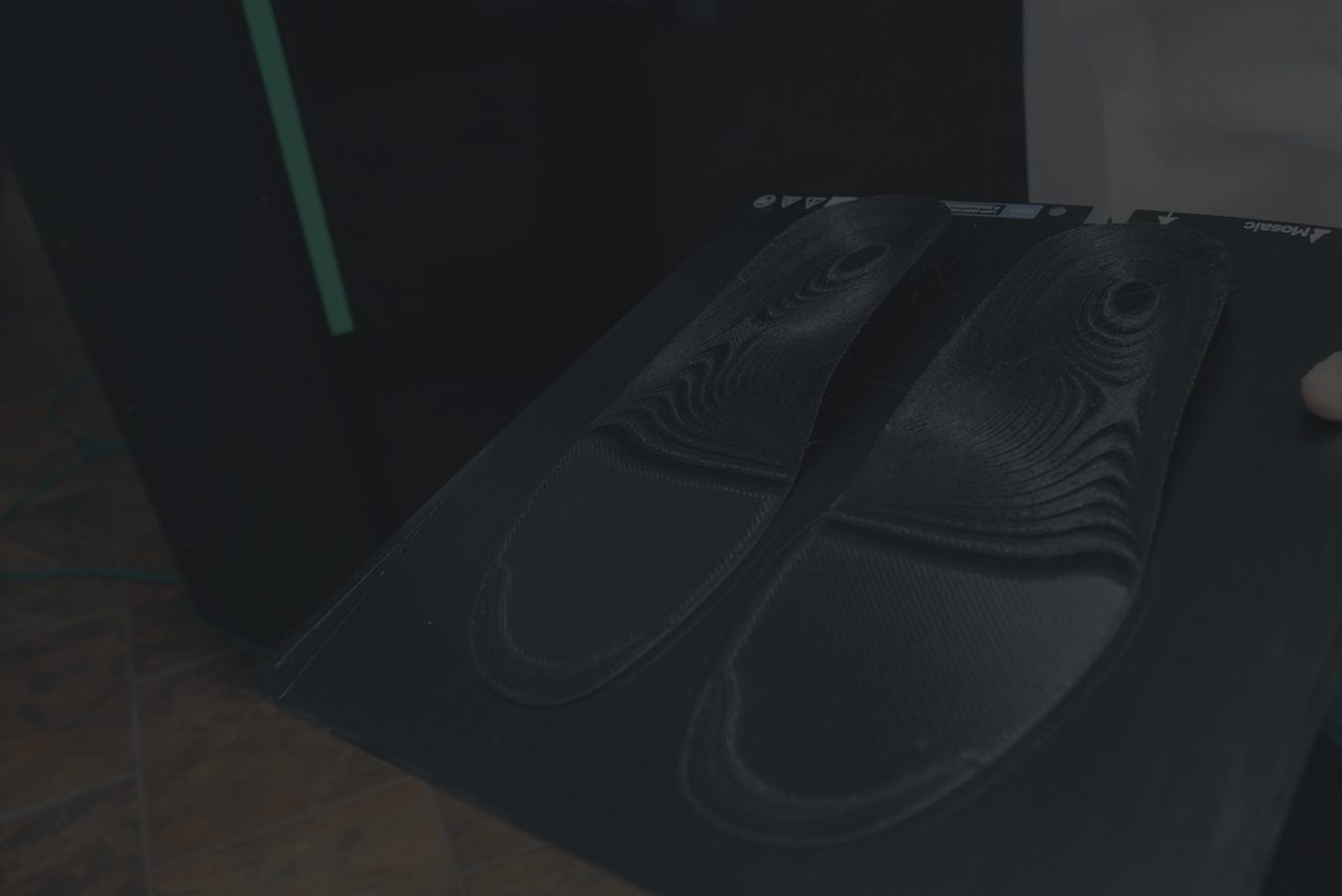
Mosaic replaces this fragmented workflow with a fully digital manufacturing approach, enabling on-demand production of custom foam packaging, case inserts, transit protection, and field-ready enclosures directly from digital files. Instead of relying on cutting, layering, and assembly, finished foam components can be produced in a single automated workflow with no tooling or minimum order quantities required.
For drone companies, custom packaging is often the lowest-risk entry point into production-scale additive manufacturing. It solves a real operational problem, protecting expensive sensors and airframes in transit and in the field, while opening the door to airframe and structural component work as confidence in the technology and the partner grows.
Mosaic works directly with aerospace and defence manufacturers to produce custom transit protection, foam inserts, field-deployable housings, and protective enclosures for UAV and sensor systems using industrial additive manufacturing and engineered foam materials, delivered on-demand and built for real-world operational environments.
Learn more about Mosaic’s aerospace and defence capabilities →
From Prototyping to Production: Scaling Additive Manufacturing in Aerospace
Additive manufacturing has been used for prototyping for more than two decades. The shift that matters now is the transition from prototype production to high-volume additive manufacturing at production scale.
This transition requires addressing several factors that prototyping environments can ignore:
- Consistent part quality across batches and over time
- Reliable material performance with documented mechanical properties
- Repeatable processes that can be validated and certified
- Traceability and documentation that satisfies defence procurement requirements
- Integration into existing production workflows and supply chain systems
- Higher throughput that does not add operational burden, Mosaic’s automated Array platform enables digital on-demand production of end-use products without proportional increases in labour or manual intervention
For defence primes evaluating whether additive manufacturing can support operational manufacturing, not just R&D, these are the deciding criteria. A system that produces excellent prototype parts but cannot demonstrate batch consistency, chain-of-custody documentation, or material traceability will not pass qualification review for flight-adjacent or mission-critical components.
Industrial additive manufacturing platforms are now being built specifically to meet these production requirements. Automated systems allow organizations to coordinate multiple machines, manage material inventories, schedule print jobs, and monitor production quality from a centralized platform, enabling higher throughput while maintaining the consistency that production environments demand.
Mosaic’s end-to-end platform is designed precisely for this environment, spanning automated hardware, industrial printers, and secure software.
Array: automated, high-volume production
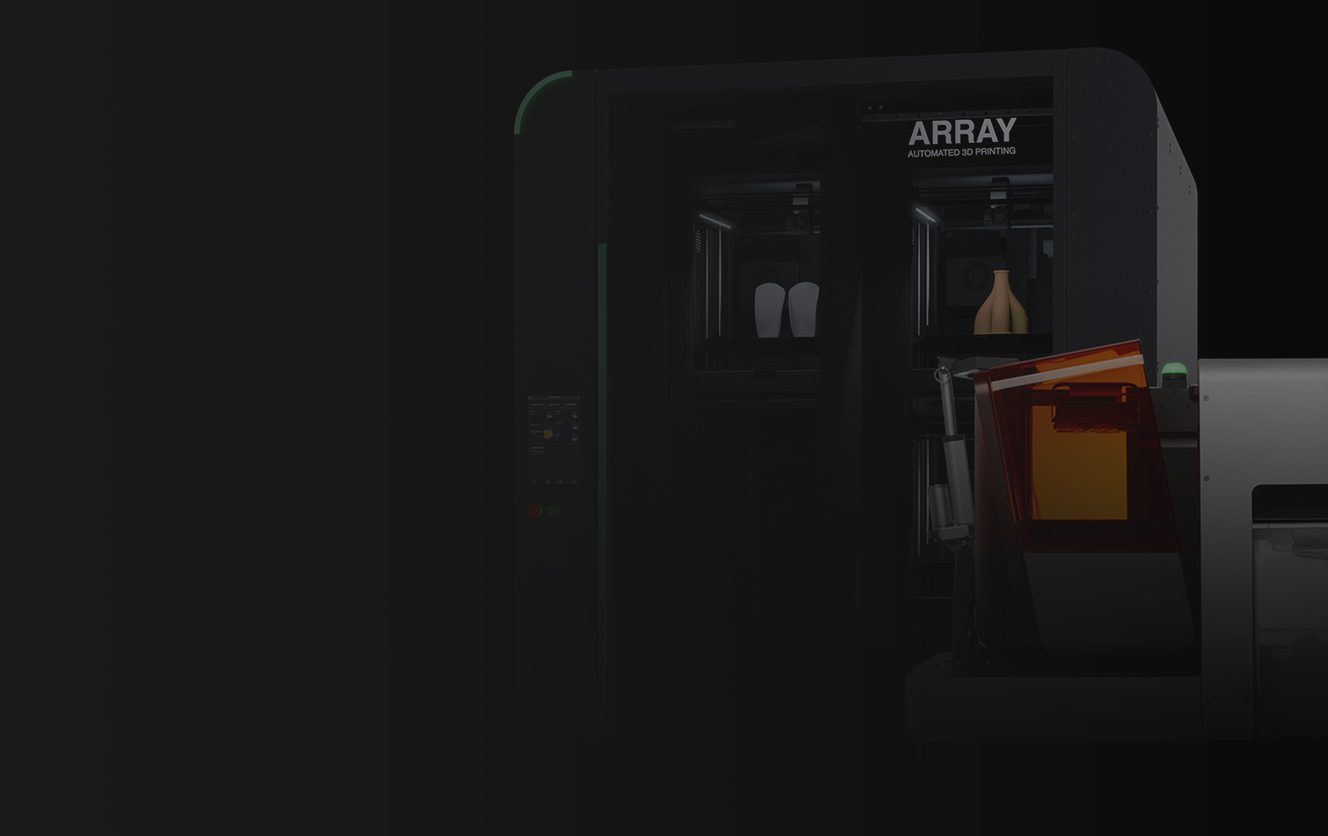
Array is Mosaic’s most advanced additive manufacturing platform, built for factory-floor production of end-use polymer parts at scale. It coordinates multiple high-temperature FFF printers through an integrated robotics gantry that automates bed placement and removal, failure detection, and part storage, enabling throughput with minimal manual intervention. Array is designed to run high-performance materials including PEEK and PEKK at production throughput. For defence primes and tier 1 contractors needing consistent, traceable, high-volume throughput, Array provides the scale that ad hoc or desktop-based approaches cannot.
Element: industrial-grade flexibility for R&D and smaller teams
Element is Mosaic’s industrial-grade multi-material 3D printer, built for teams that need high-performance manufacturing capability without the full footprint of Array. It is the right starting point for defence R&D programmes, drone manufacturers in early production scaling, and organizations evaluating additive manufacturing before committing to full automation. Element supports advanced thermoplastics and composites, runs on the same Canvas software platform as Array, and is designed as a stepping stone; teams that start on Element can scale to Array without changing their workflow, materials, or qualification baseline.
Canvas: intelligent software with secure, offline-ready deployment
Canvas is Mosaic’s unified digital manufacturing software platform. It manages the full workflow from geometry preparation and material selection through automated job queuing, fleet management, and production documentation.
For aerospace and defence customers specifically, Canvas is available as a self-hosted desktop application, meaning it can be deployed in air-gapped, offline, or classified environments without any dependency on cloud connectivity. This is not a minor technical footnote. Defence organizations operating in secure facilities, forward deployments, or classified programme environments need manufacturing software that functions entirely within their own infrastructure. Canvas Desktop is built for that requirement.
This is vertically integrated manufacturing built for the aerospace and defence sector: hardware, software, and materials designed to work together from first prototype through full production scale.
Materials for Aerospace and Defence Additive Manufacturing
Material selection determines whether a 3D printed aerospace part can be qualified for its intended application. For aerospace and defence, the requirements are demanding. Components must withstand high temperatures, chemical exposure, mechanical stress, and vibration across long service lifecycles. Improving part durability in defence systems starts with choosing materials engineered for those conditions.
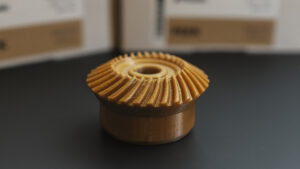
PEEK
PEEK (polyether ether ketone) is one of the most capable engineering thermoplastics used in 3D printing aircraft parts and aerospace components more broadly. It is used in structural components, protective housings, wire shielding, and other applications where strength, thermal resistance, and low flammability are required.
PEEK’s combination of mechanical performance and chemical resistance makes it a natural fit for demanding aerospace environments where reliability over long service periods is non-negotiable.
PEEK
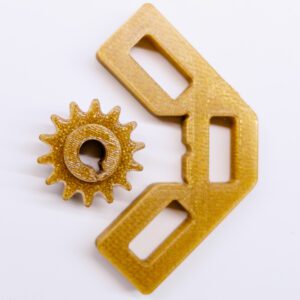
PEKK (polyether ketone ketone) offers high chemical resistance and excellent mechanical properties, making it well suited for defence applications where parts must perform reliably under harsh conditions. It also offers strong printability characteristics, which matters in production environments where consistency and repeatability are critical to maintaining qualification standards.
Carbon-Fibre-Reinforced Composites
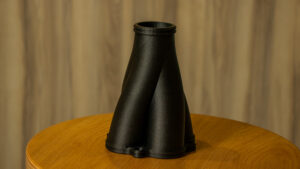
Carbon-fibre-reinforced nylon and similar composite materials offer exceptional strength-to-weight ratios. Mosaic Matrix, a carbon-fibre-reinforced nylon blend, enables engineers to produce durable 3D printed aerospace parts with excellent structural performance and smooth surface quality. These materials are used across aerospace components, robotic systems, protective casings, and structural applications where weight reduction is as important as mechanical performance.
Carbon-fibre-infused materials can deliver substantial improvements in strength-to-weight ratios compared to standard polymers. For drone manufacturers optimizing for flight performance, that improvement directly translates to range, payload capacity, and operational endurance.
Nylon
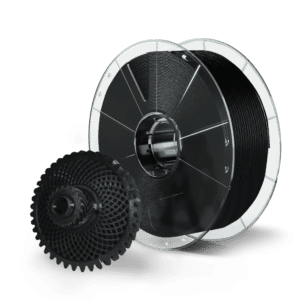
Nylon is a versatile, high-toughness engineering thermoplastic well suited to structural aerospace applications where impact resistance, fatigue performance, and lightweight construction are all required. It is used in brackets, housings, cable management components, and load-bearing assemblies where metal replacement is the goal. Mosaic Nylon offers consistent printability and strong layer adhesion, supporting the batch-to-batch repeatability that production and qualification environments demand.
FR-PC (flame-retardant polycarbonate)
FR-PC is a flame-retardant polycarbonate engineered for applications where fire safety is a hard requirement. In aerospace and defence, this includes interior enclosures, electronics housings, connector covers, and any component installed in proximity to electrical systems or fuel lines. Mosaic FR-PC meets the mechanical performance expectations of polycarbonate, impact resistance, dimensional stability, and good thermal tolerance, while providing the flame-retardant properties that aerospace qualification often mandates.
Compliance, Security, and IP: What Defence Buyers Evaluate
For organizations operating in the defence sector, technical capability is only part of the equation. Long-term viability as a supplier depends on how well a vendor aligns with evolving expectations around compliance, data security, and intellectual property protection. These factors are assessed early in the procurement process and continue to shape vendor relationships throughout program execution.
Across North America and Europe, requirements are becoming more stringent and more explicitly enforced. Frameworks such as CMMC in the United States, domestic sourcing policies tied to the NDAA, and national procurement strategies like Canada’s Build-Partner-Buy initiative are reshaping how suppliers are evaluated. Increasingly, defence buyers are prioritizing partners who can operate within controlled environments, support traceability, and align with secure, regionally anchored production models.
For defence primes, drone manufacturers, and procurement agencies, these considerations are not administrative hurdles, they are central to how risk is assessed and how supplier decisions are made.
Mosaic’s platforms are designed to support structured, controlled manufacturing workflows, with an emphasis on traceability, process consistency, and centralized production management. Canvas enables teams to manage files, materials, and production processes within a unified system, helping organizations maintain visibility and control as they scale additive manufacturing operations.
Designed and manufactured in Canada, Mosaic provides a domestically developed additive manufacturing solution that aligns with the broader industry shift toward secure, regionally based production ecosystems.

The Future of 3D Printing in Aerospace and Defence
Three trends will define how additive manufacturing adoption develops across the aerospace and defence sector over the next decade.
Distributed production networks. Defence organizations will continue building localized manufacturing capabilities to improve readiness and reduce supply chain vulnerability. The model is not centralized factories shipping to the field. It is a network of qualified production nodes that manufacture on demand, wherever parts are needed. The defence distributed 3D printer concept is moving from strategy to operational reality.
Advanced materials. High-performance polymers and composites will continue expanding the range of components that can be produced through additive manufacturing in aerospace. As material qualification data accumulates and certification pathways mature, more flight-critical and mission-critical applications will become accessible to additive methods.
Production-scale automation. The shift from manual additive manufacturing to automated, high-volume additive platforms is already underway. Organizations that can run continuous production with minimal intervention, consistent quality, and documented traceability will scale in ways that ad hoc or desktop-based approaches cannot support.
Mosaic is building the automated platforms, intelligent software, and materials systems that help aerospace and defence organizations lead this shift rather than respond to it. From early-stage R&D through production-scale, compliance-ready manufacturing, our end-to-end additive solutions are designed to scale with your program requirements.

Ready to Strengthen Your Aerospace and Defence Manufacturing Capability?
Whether your organization is a defence prime managing legacy parts and qualification requirements, a drone manufacturer scaling from prototype to volume production, or a procurement agency building sovereign manufacturing capacity, the core question is the same: can your current manufacturing setup deliver the speed, traceability, and domestic-origin compliance that modern defence programs demand?
Mosaic helps aerospace manufacturers, defence contractors, and government teams implement secure, scalable 3D printing systems built for production environments. As a trusted partner in the additive manufacturing aerospace industry, we work with your team from the earliest evaluation stage to understand your production goals, supply chain challenges, and compliance requirements, ensuring that additive manufacturing becomes a durable strategic advantage for your organization.
Contact our team to discuss how Mosaic’s additive solutions can support your aerospace and defence production strategy.