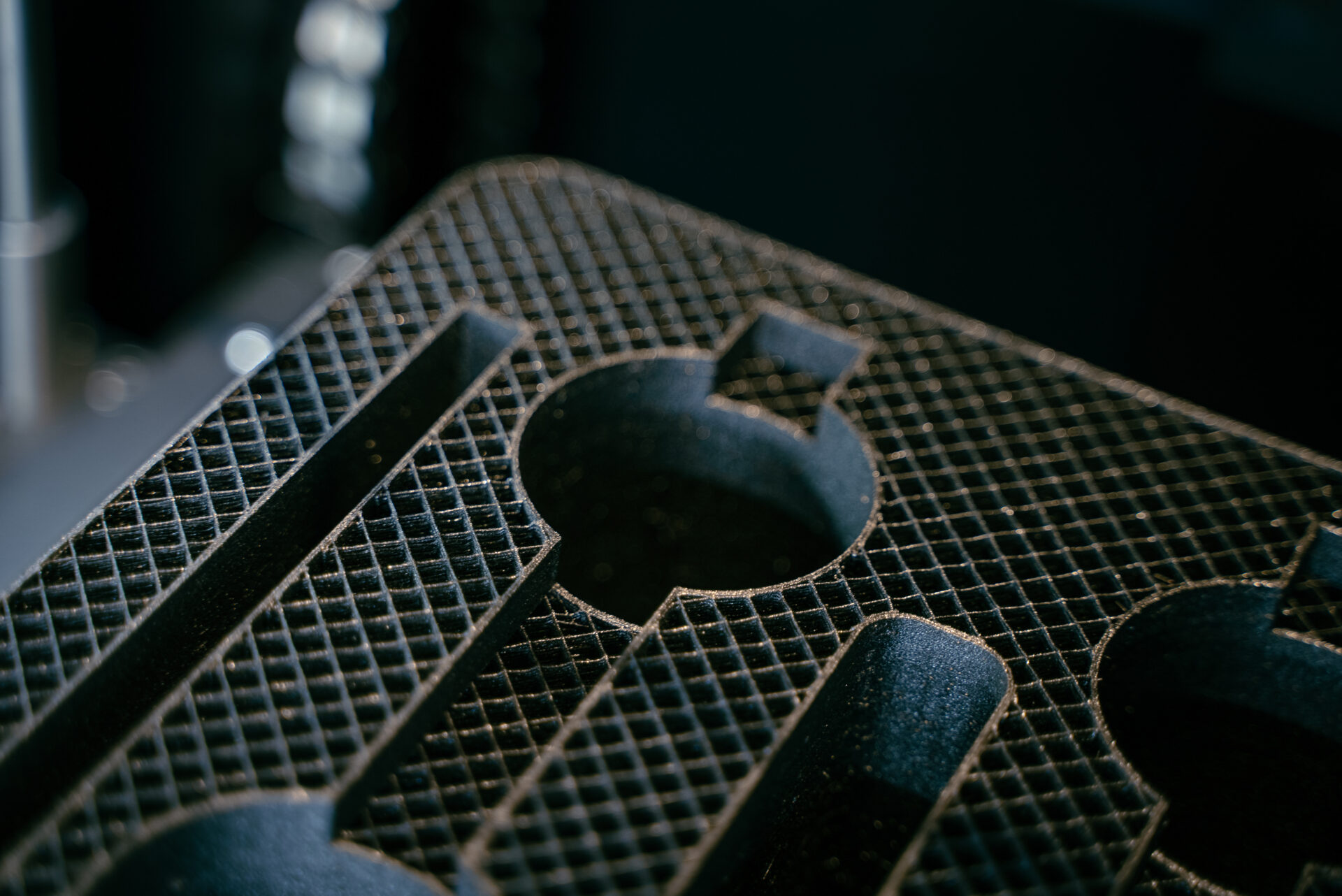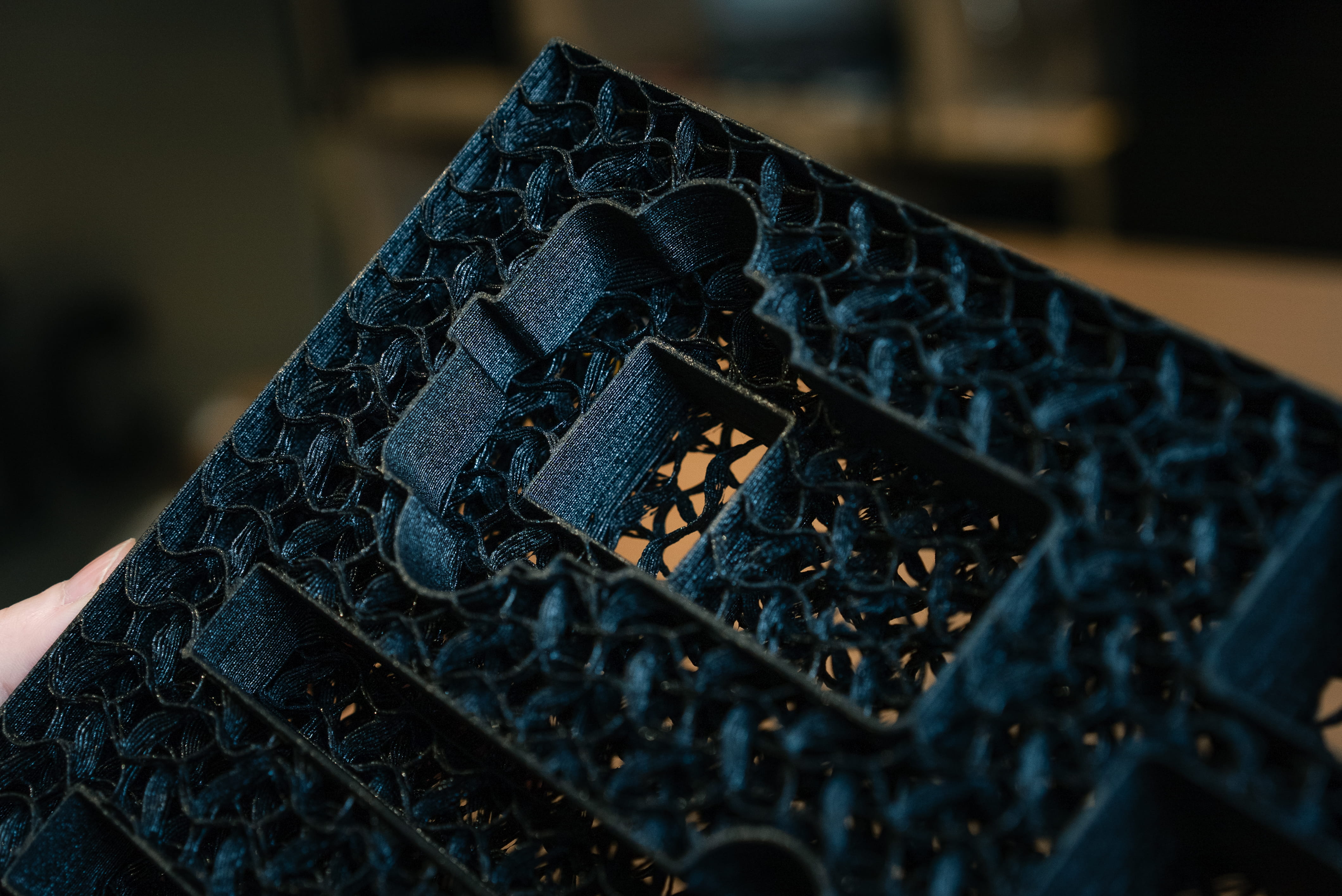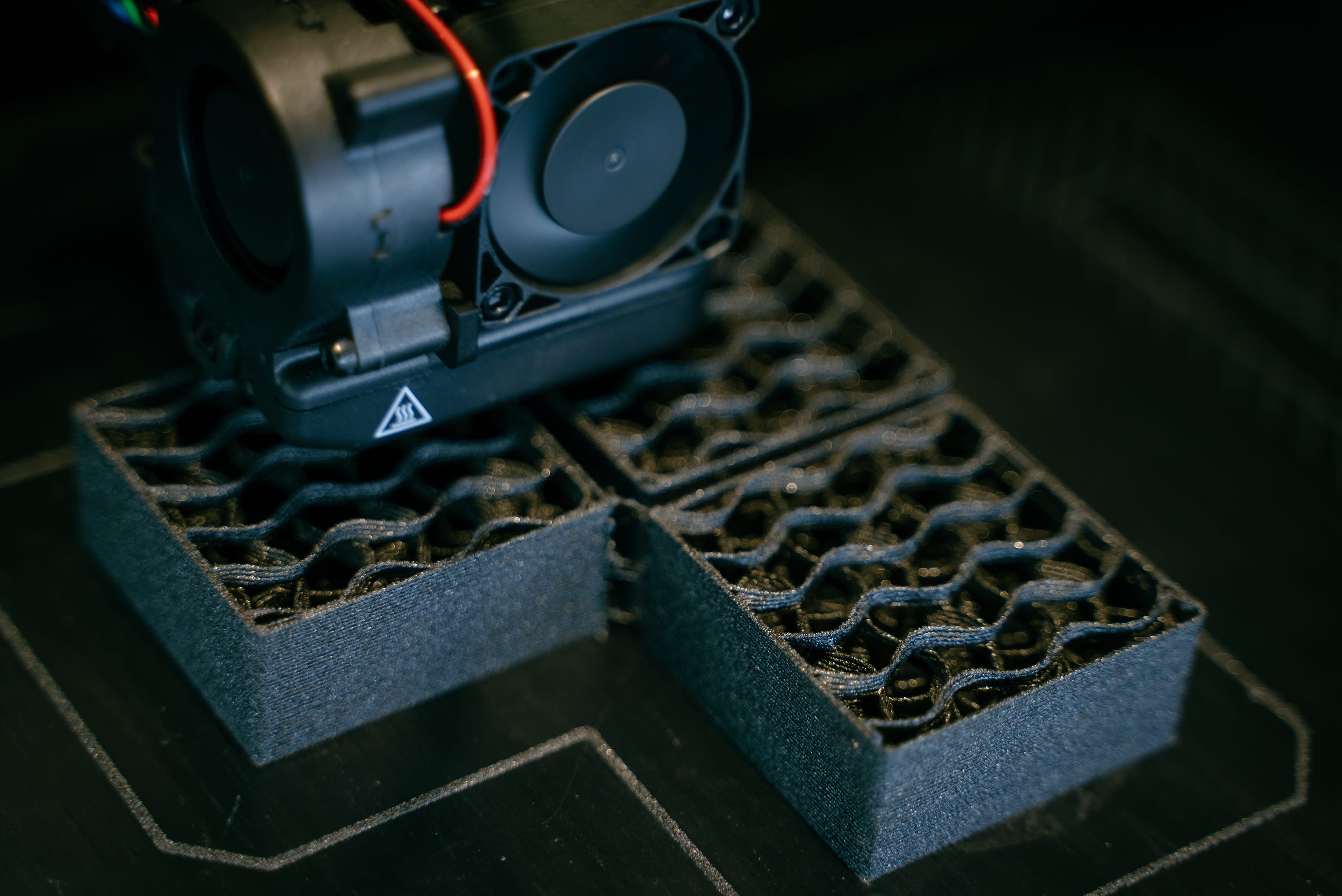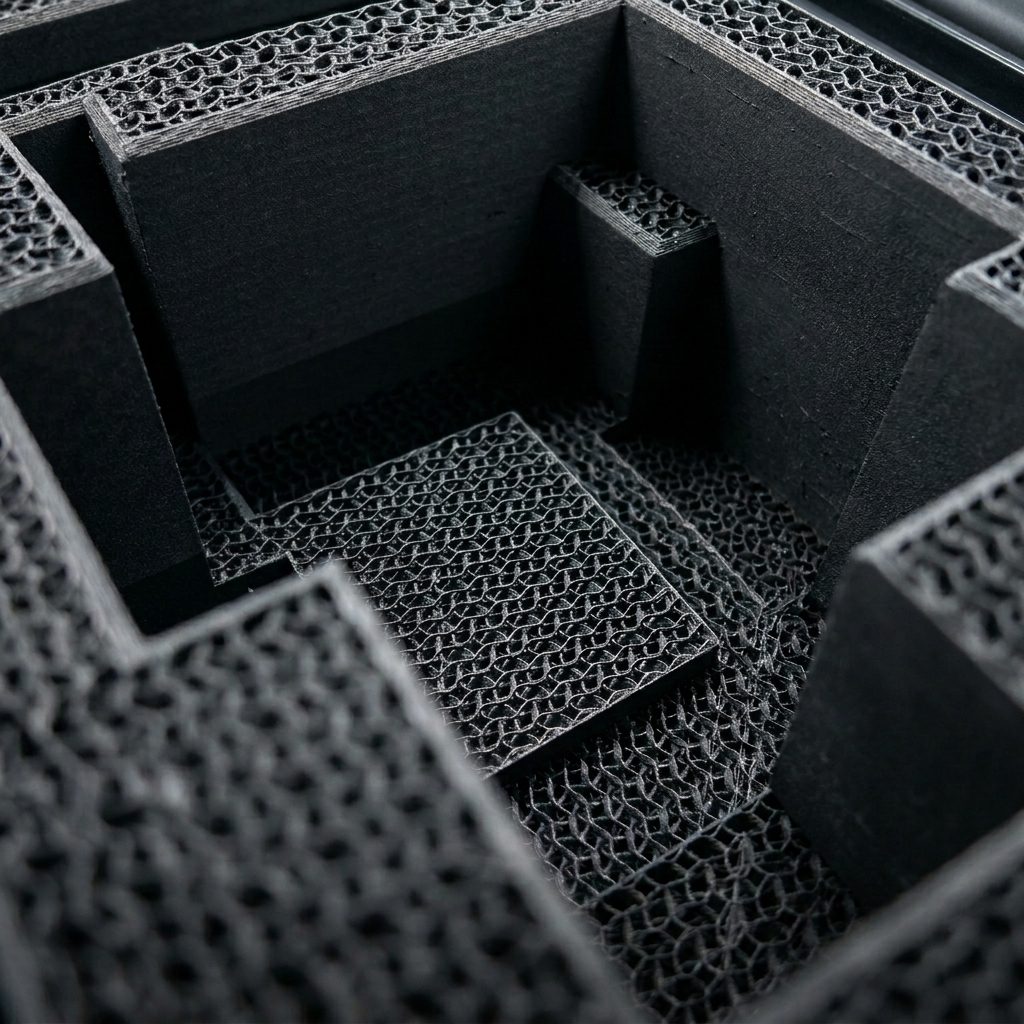
In manufacturing environments, foam inserts support everyday operational workflows: shadow boards keep tools organized, WIP trays protect parts between operations, dunnage reduces transit damage, and packaging inserts protect finished products.
The problem is not that foam does not work. It is that getting the right foam, when you need it, for a geometry that may change next quarter, is slow, labor-intensive, and surprisingly expensive.
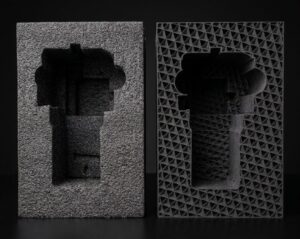
This post explores how 3D printed foam inserts are used across packaging, shadow boards, WIP trays, and dunnage applications, and why on-demand additive production is increasingly replacing supplier-driven foam workflows for low-volume, fast-changing applications.
The lean waste hiding in your foam procurement
Every time a product line changes and new dunnage needs to be ordered, there is a lag. Every time a 5S audit flags inconsistent shadow board cutouts between sites, there is a compliance gap. Every time a custom insert requires a physical sample for approval, there is a delay built into the process.
These issues map directly to common lean waste categories:
- Waiting waste: delayed foam deliveries during line changes or audit preparation
- Defect waste: inconsistent cut quality, poor fitment, and part damage from inaccurate dunnage
- Motion waste: time spent locating tools or managing excess foam inventory
- Overproduction waste: bulk ordering to satisfy supplier minimums rather than actual operational demand
3D printed foam inserts can significantly reduce these operational inefficiencies by enabling on-demand production directly from digital files. Output is consistent run to run and site to site from the same digital file. And because there is no minimum order, there is no reason to overproduce
The lead time problem, by the numbers
The most concrete argument for 3D printed inserts is lead time. Here is how on-demand printing compares to commercial foam suppliers across common manufacturing applications:
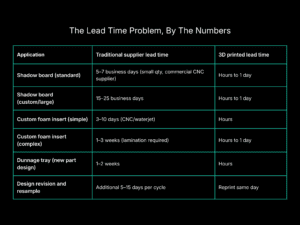
The 5-25 day range for shadow boards is not theoretical. Commercial CNC foam suppliers consistently quote 5-7 days for small standard quantities and 15–25 business days for larger or more complex orders. When a product line changes or a 5S audit surfaces an inconsistency, that timeline is not acceptable.
3D printing eliminates it. A shadow board foam insert goes from a digital file to a finished part in hours, the same day in most cases, with no supplier relationship required.
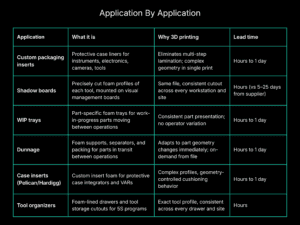
Application by Application
Shadow Boards
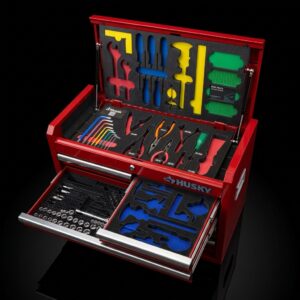
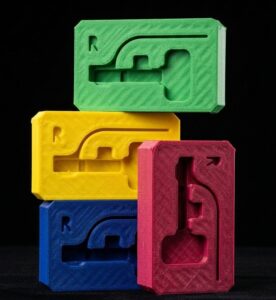
Shadow boards are the highest-visibility lean application for 3D printed foam. The value proposition is straightforward: exact tool profiles, produced from the same digital file across every workstation and facility, in hours rather than weeks.
The operational advantages extend beyond speed. When a tool is added or removed from a station, the shadow board foam can be updated and reprinted that day, without calling a supplier, without a minimum order, and without waiting two to three weeks for the replacement. 5S compliance becomes a matter of updating a file, not managing a procurement cycle.
For multi-site manufacturers, this is particularly significant. The same digital file produces the same foam insert across every location, eliminating the variation that comes from each site managing its own supplier relationship and cutting process.
WIP Trays
Work-in-progress trays are one of the highest-frequency foam needs in a production environment. Every part moving between operations requires a tray or carrier that fits its geometry, and when parts change, trays need to change with them.
Traditional WIP tray production through external suppliers carries the same lead time problem as shadow boards, compounded by the fact that WIP tray changes often happen in response to engineering changes that themselves require rapid implementation. A two-week lead time for new WIP trays is a constraint on how quickly the line can respond to product changes.
3D printed WIP trays are produced from the part’s digital geometry, same day, with consistent cutout accuracy across every tray in the run. When the part changes, the tray file can be updated and reprinted immediately, significantly reducing the lag between engineering changes and production implementation.
Dunnage
Dunnage, the foam padding, separators, and supports used to protect parts in transit between production operations, is often overlooked in lean assessments because it is individually low-cost. The aggregate impact is significant: parts damaged by poorly fitted dunnage create rework, delay downstream operations, and, in some cases, trigger quality holds.
On-demand dunnage produced from digital part geometry improves fit consistency while eliminating the inventory overhead associated with stocking multiple foam variants. For operations running multiple part variants, digital dunnage management is significantly more efficient than managing physical foam stock for each variant.
Custom Packaging Inserts
For operations that ship finished products to customers, or that package sub-assemblies for internal logistics, custom inserts protect parts and present them professionally. The traditional approach involves either expensive die-cut tooling for high volumes or manual CNC/waterjet cutting for custom work.
For low-to-medium volume custom packaging, 3D printed inserts eliminate tooling cost, reduce lead time from days to hours, and allow complex geometries, multi-cavity inserts, parts with variable depth, irregular geometries, that would otherwise require multi-step lamination and assembly workflows.
Multi-site File Replication
One of the most underappreciated benefits of digital foam production: the same file produces the same insert at every location. For manufacturers operating multiple facilities, this means 5S programs, dunnage standards, and packaging specifications are enforced through a digital file rather than through operator training and supplier management at each site.
Getting started: what a first application looks like
For most operations, the best starting point is a single application where lead time, inconsistency, or supplier dependency is already creating operational friction:
- Shadow boards where cross-site consistency or audit responsiveness is a challenge
- WIP trays or dunnage where engineering changes frequently impact production flow
- Custom packaging inserts where low-volume orders or geometry complexity make traditional sourcing inefficient
- Initial evaluations are typically straightforward: validate fit, durability, turnaround time, and operational impact on a small pilot application before expanding usage.
The evaluation questions are straightforward: does it fit? Does it hold up? Is the turnaround materially faster? For most operations, the answer to all three is yes within the first pilot.
About Mosaic Stitch
Mosaic Stitch is the foamed elastomeric filament engineered for these applications, designed as a direct replacement for the PE, XLPE, and EVA foams used across most protective packaging, shadow board, dunnage, and WIP tray applications. It offers tunable density, abrasion and chemical resistance, a smooth surface finish, and 20+ color options for visual management programs.
Stitch runs on existing FFF printers using standard slicer profiles, with no minimum order quantity and on-demand production directly from digital files.
Contact our team to discuss whether Stitch is the right fit for your foam manufacturing application.