The shift toward digital orthotics production is well underway. Most labs have adopted at least one digital tool, a 3D scanner, a CAD design package, and a practice management system. Some have added 3D printing. A smaller number have tried to connect all of these into something resembling an end-to-end workflow.
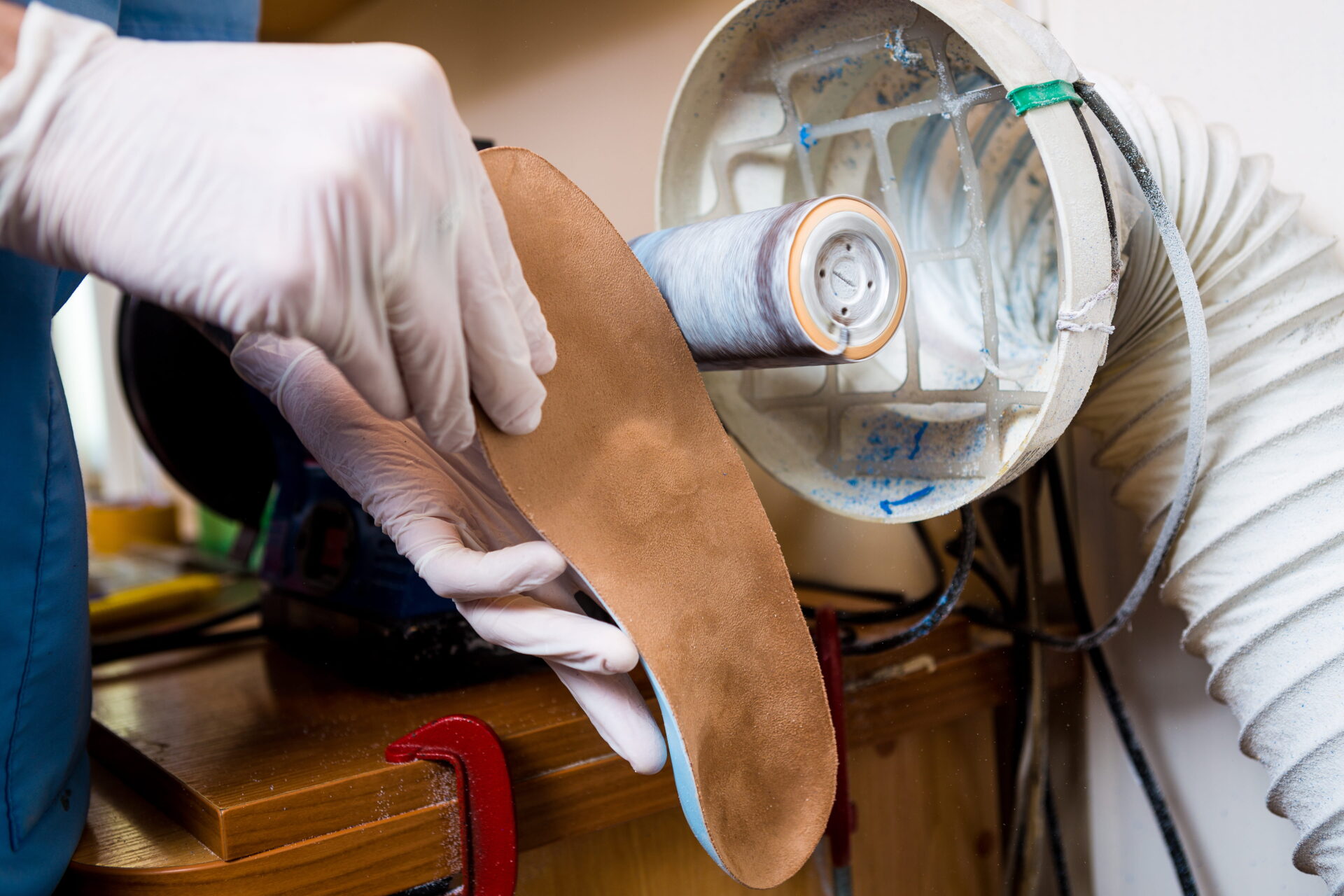
The result, in most cases, is a stack of point solutions: capable individually, fragmented collectively, and held together by manual file transfers, format conversions, and institutional knowledge about which tool talks to which other tool and in what order.
That fragmentation has a cost. And as production volume scales, that cost scales with it.
What is the difference between a platform approach and point solutions in orthotics manufacturing?
A point solution solves one problem in isolation, a scanner captures geometry, a CAD tool designs a device, each stops there. Integration is the customer’s responsibility: exports, conversions, manual re-entry.
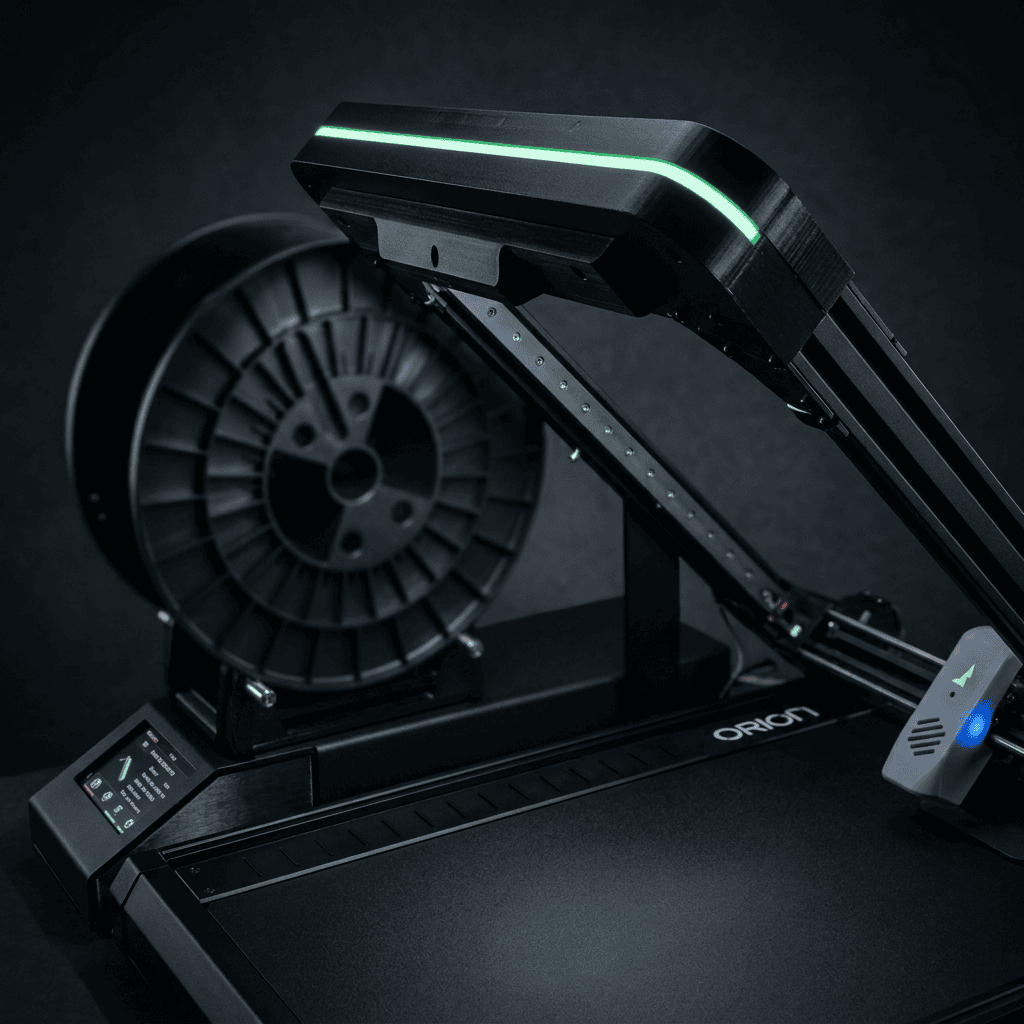
A platform connects those functions so data flows between steps without manual intervention, governed by the system rather than individual coordination. Orion and Stryde are a platform: Stryde Scan captures geometry and prescription details in one step; Stryde Design uses that data directly, no export or conversion; Stryde Manage tracks every patient and revision in one place; Stryde Print connects directly to Orion’s continuous, automated production, no manual slicing or queue management.
→ Learn more about Orion | Stryde Software Suite
Every step stays connected, prescription intent established at scan carries through design, management, and the finished device with no drift, no lost data, no workaround required.
How does Orion’s ecosystem reduce operational risk in orthotics production?
In a point-solution workflow, risk lives at every integration gap, a file that won’t import, a re-entered detail that’s wrong, a modification that never reaches the floor. Manageable at low volume; systemic at scale.
Fewer handoffs, Fewer failure points
Stryde eliminates manual transfers between scan, design, and production, data entered once flows through automatically.
Prescription intent preserved end-to-end
No missed export fields or lost production notes, the prescription specified at intake governs the finished device.
Repeat orders from stored data, not memory
Stryde Manage holds complete history, so repeat orders execute from stored specs, eliminating drift between original and repeat devices.
Vendor consolidation
Mosaic owns the full ecosystem, hardware, software, materials, one vendor, one support relationship, one accountable partner.
How does platform thinking affect orthotics production scalability?
Point solutions scale awkwardly, more volume means more file transfers and coordination overhead, and that load falls on people, not systems. A platform scales differently: adding volume means adding capacity within a consistent workflow, not adding complexity to it.
Orion scales by adding units
Each joins the same Stryde ecosystem, same tools, same queue scheduling. Training and management overhead don’t increase with unit count.
Multi-site expansion replicates a proven system
Rather than rebuilding an integration layer at each new location — standardization is a platform property, not a management achievement.
Economics improves with scale without requiring it to start
Orion’s continuous, automated production delivers as low as $6/pair in material cost at a single unit’s volume, improving further as units are added, with no workflow redesign required.
→ Related: Why Multi-Site Orthotics Labs Struggle with Standardization | The Economics of Scaling Orthotics Production With Orion
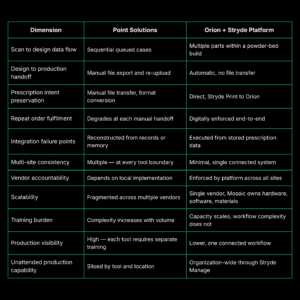
What should operations leaders evaluate when choosing an orthotics production platform?
Total workflow coverage, not tool capability
The best scanner and best CAD tool don’t make a capable workflow if disconnected. Evaluate the full scan-to-device path, including every handoff where intent could drift.
Integration ownership
Scalability without platform switching
Standardization as a system property
Materials as part of the ecosystem
Evaluate whether materials are purpose-engineered and validated for orthotic production, or left to the customer with unknown compatibility risk.
→ Related: How Belt-Based 3D Printing Is Changing Orthotics Production | From Scan to Finished Device: The Orion + Stryde Workflow Explained
Build on a Platform – Not a Stack
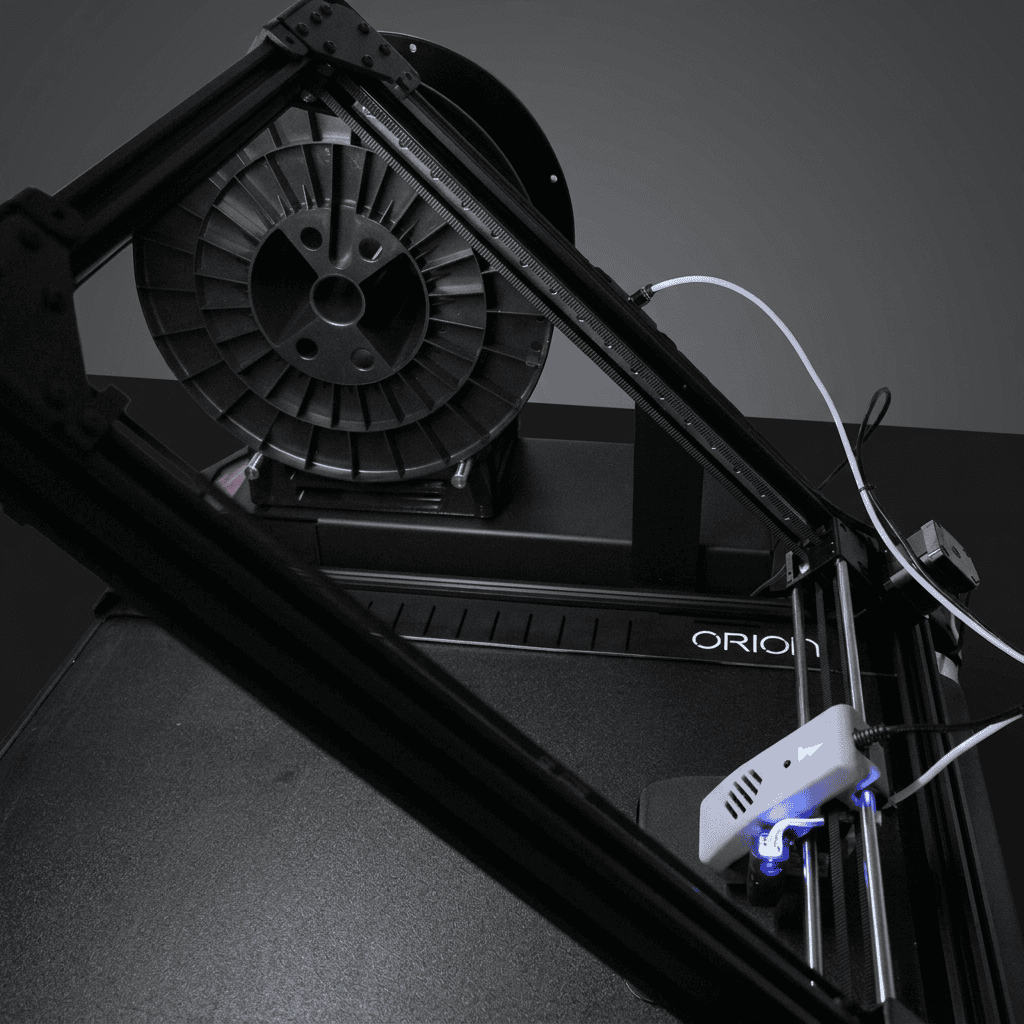
For orthotics organizations scaling across multiple sites, Mosaic Manufacturing offers a production ecosystem built for consistency: Orion, a belt-based 3D printer engineered for continuous, automated manufacturing, and Stryde, the software suite that keeps every location on one connected digital workflow from scan to finished device.
If your organization is evaluating production platforms, or auditing the integration gaps in your current point-solution stack, contact our team to discuss your production architecture and growth goals.
Contact us at sales@mosaicmfg.com | mosaicmfg.com